Workshops
How I can help · Workshops and diagnostics

Real change occurs over a sustained period of time.
Keynotes provide thought leadership; workshops give that thinking the time it needs to take hold.
Awards and recognition
Research shows that mental models need to be reformed, and Craig follows Otto Scharmer’s Theory U, a process of divergence and convergence, to create longer-term change (C. Otto Scharmer, Theory U: Leading from the Future as It Emerges, Society for Organizational Learning, 2007). As a result, Craig runs both bespoke workshops and two freemium tools where learning is based on peer learning and heavily surfaces findings from leaders and organisations.
Free to start
Two freemium tools
Craig runs both bespoke workshops and two freemium tools where learning is based on peer learning and heavily surfaces findings from leaders and organisations.
The diagnostic
WhatTheForesight
The diagnostic scores a leadership team across 25 attributes grouped into leadership, organisation and landscape. Each respondent answers twice, once for where the organisation stands today and once for where they expect it to stand in future.
The base diagnostic is free, with analytics and a dashboard, while the premium tier adds demographic comparison and a consulting action report commensurate with the Big 4 consulting houses.
The simulation
DRIFT
DRIFT is a strategy simulation. Six teams take the positions inside one industry ecosystem as incumbent, regulator, government, startup, market leader and wildcard, playing five rounds across ten simulated years with between six and 42 players, while an AI plays the market and scores every decision.
The online simulation is free to play, with an in-person debrief as a paid engagement.

The diagnostic
WhatTheForesight
Boards track financial health continuously, but future readiness is not one of those factors, as there has never been a way to surface it. In his 4.5-year PhD, using mixed-method analysis, Craig found 25 attributes that organisations should focus on to be successful in the future. He subsequently created WhatTheForesight, a sentiment-based, swarm-theory tool that measures these factors both today and in the future, where both scores and the delta between them form the unit of analysis.
The diagnostic scores a leadership team across 25 attributes grouped into leadership, organisation and landscape. Each respondent answers twice, once for where the organisation stands today and once for where they expect it to stand in future.
It was built on 759 leaders in 157 organisations across 21 sectors and four countries over four years, which is the same dataset the Boat Lock model comes out of. Three or more respondents from one leadership team is the minimum for a reliable score, and the spread between them is itself a reading, because teams that disagree about their own capabilities perform worse than their scores on their own would predict.
The base diagnostic is free, with analytics and a dashboard, while the premium tier adds demographic comparison and a consulting action report commensurate with the Big 4 consulting houses. The dimensional analysis and action report are generated from the baseline result in minutes, at 10x the value and 10% of the cost of the equivalent consulting engagement, and enterprise benchmarking is also available.
Run the diagnostic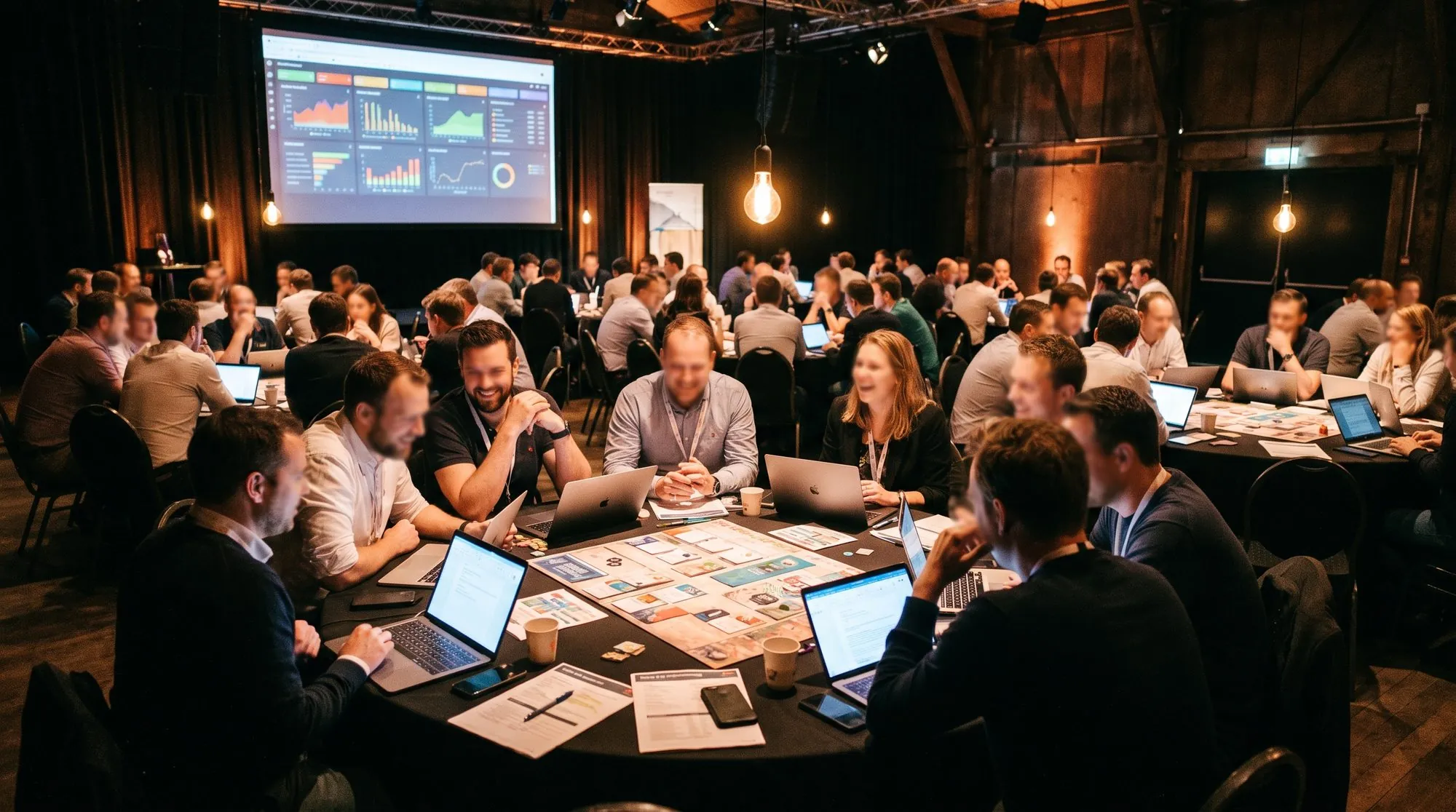
The simulation
DRIFT
DRIFT is a strategy simulation. Six teams take the positions inside one industry ecosystem as incumbent, regulator, government, startup, market leader and wildcard, playing five rounds across ten simulated years with between six and 42 players, while an AI plays the market and scores every decision.
DRIFT stands for Decisions, Rounds, Intelligence, Futures, Trajectory. The final report measures how far each team drifted from the future it wanted in round one, and how it deviated through each year as new challenges and black swans arrived and competitors reacted. A leadership team states its strategy at the opening and then spends ten simulated years (over five rounds) deciding on the actions that best lead to that ten-year outcome.
The facilitated debrief analyses what the team did, why it reacted to certain moves, any political moves or conversations that materially affected decisions, alliances made in (and out of) the room, and much more.
It runs in three formats: a two-hour sprint with fifteen-minute decision windows; a half-day offsite; and a full working week with a suggested hour a day, where decisions made in round one carry consequences across the entire simulation. Scoring can be done by the participants, by AI (paid), by a facilitator (paid) or any mixture of these.
The online simulation is free to play, with an in-person debrief as a paid engagement.
Play at playscenarios.com
The game
Find the Fish
Find the Fish is a facilitated game that has been run around the world, most regularly in Evian, Hyderabad and South Africa. While structured as a game, it tests a team’s leadership, communication and teamwork through inter- and intra-team dynamics and complex problem solving. Culture surfaces through the play, and the biases holding a company back become visible; these not only determine how the game unfolds, but likely shape the organisation’s operating model day to day. Structured as a high-pressure, low-stakes engagement, it lets attendees reveal their biases and typical preferences, irrespective of what they know they should do.
While the diagnostics surface where an organisation sits, the workshops are where a team works out what to do about it. Programmes run from a single session to five days, with up to three sessions daily, and combine presentation, facilitated discussion, group work and, where it serves the outcome, either of the simulations above. Content is built against what the client needs to leave with.
Craig holds adjunct faculty positions at the Indian School of Business and the University of Johannesburg, is a faculty member at Duke Corporate Education, lectures for the African Fellows Leadership Initiative and is an associate of the Wits Tayarisha School of Governance. Clients have run these programmes to build strategy, to test whether a leadership team is aligned in practice as well as on paper, and to work through succession between generations.
Preparation
hardens decisions.
He takes bookings for keynotes, MC and hosting, workshops and advisory work, both directly and through speaker bureaus.
Book Craig